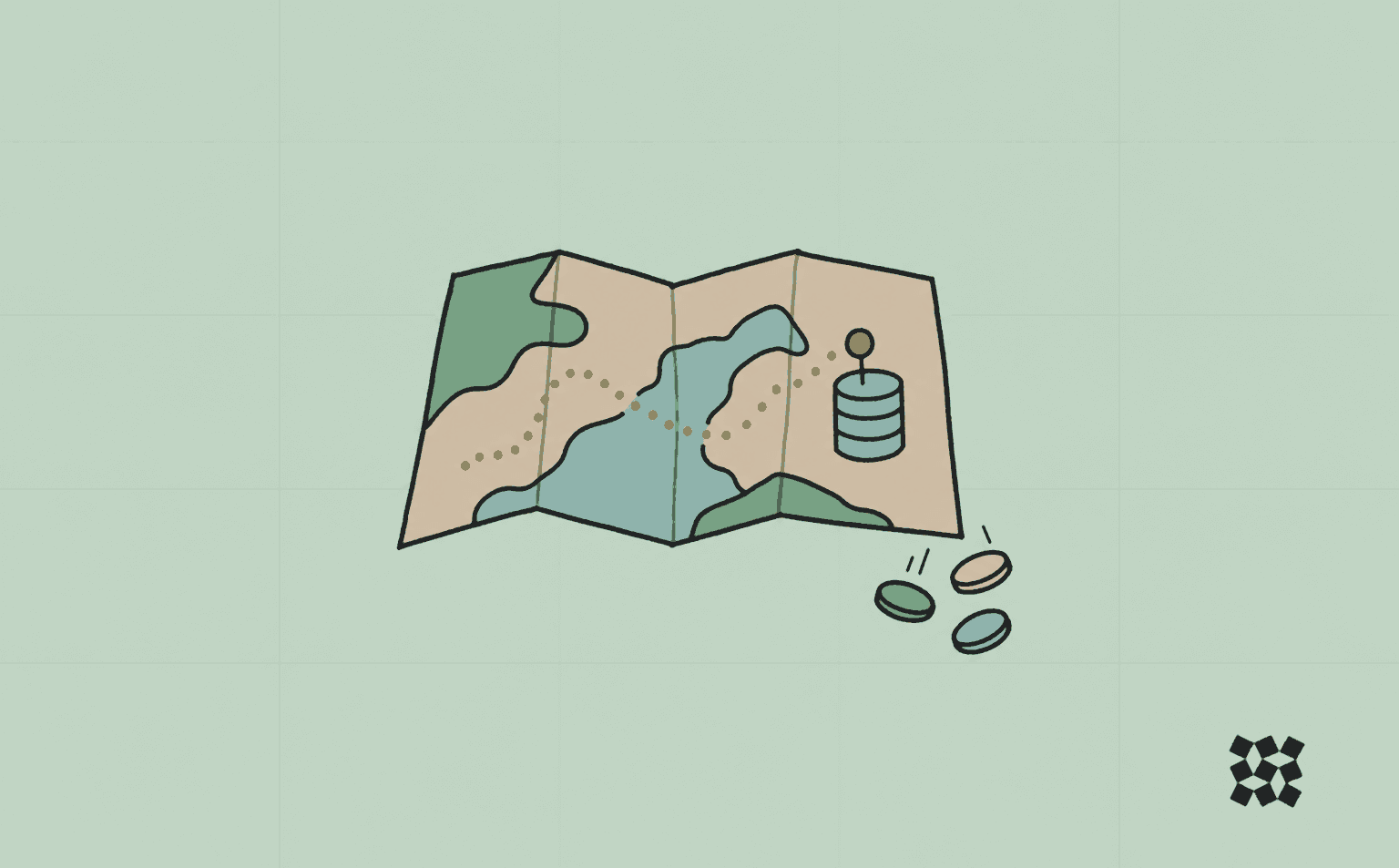
The cheapest way to cut your AI bill isn't a cheaper model. It's giving the model you already have a map.
Recently, one of our largest customers asked us a blunt question: "How much will Structify actually save us on token spend?" It's a fair question. Everyone's AI bill is climbing. So instead of hand-waving an answer, our CTO, Alex Goldstein, went and measured it. We would rather show hard data than make promises.
The experiment
We anonymized roughly 10,000 real customer queries, distilled them down to several hundred, and ran them against a representative set of business systems: an accounting system, a CRM, a product database, a ticketing system, and a customer service tool.
Same AI model. Same questions. The only difference was what the model had to work with:
- Run 1: Claude on its own, figuring out the data from scratch.
- Run 2: Claude with Structify's context layer giving it a map of the data.
Then we did the whole thing twice: once on Claude Opus, the heavy hitter, and once on Claude Haiku, the small, fast one.
The results
Here's how each model performed with Structify's context layer, compared to running on its own.
Opus with Structify- 22% cheaper
- 29% faster
- 46% fewer queries to data sources
- 40% fewer wrong answers
- 20% cheaper
- 25% faster
- 44% fewer queries to data sources
- 35% fewer wrong answers
Cheaper, faster, and more accurate on both the biggest model and the smallest.
There was one more result we didn't go looking for. Running on its own, Haiku leaked credentials in 8 of 72 runs, which is a serious security problem. With Structify, there were zero leaks across 144 runs.
Why a map changes the math
When an AI agent hits your data cold, it has no idea what's there, so it explores. It queries one table to see what's inside, then another, then another. Every lookup burns tokens, adds latency, and exposes the agent to more data than it needs to see.
Structify hands the agent a map before it starts.
Every night, we scan every connected data source for changes. A new table gets documented. A new column gets a note on what it means. A deleted column disappears from the docs. Messy free-text fields, like a "City, ST" column, get their pattern captured so the agent reads them correctly. And every conversation with Structify adds more context, so the map gets sharper over time.
Claude's built-in memory is tuned for general use. Ours is tuned to your data. Less wandering means fewer queries, lower cost, faster answers, and an agent that doesn't stumble into places it shouldn't.
What it's worth
For a company spending $1M a year on tokens, 22% is $220K back, on top of everything else Structify does.
I'm proud of how this one came together. A customer asked a hard question, and instead of a pitch, they got an experiment. That's what it looks like when your CTO would rather prove things than sell them.
If your token bill keeps climbing and you're curious what this looks like on your own data, get in touch. We're happy to walk you through it.